
CAPUD does a lot of work with other national and regional drug policy organizations. Some of these are from working groups formed by The Dr. Peter AIDS Foundation, Westside Harm Reduction, STIMULUS, and more.
Here are some of our outcomes from our collaborations.
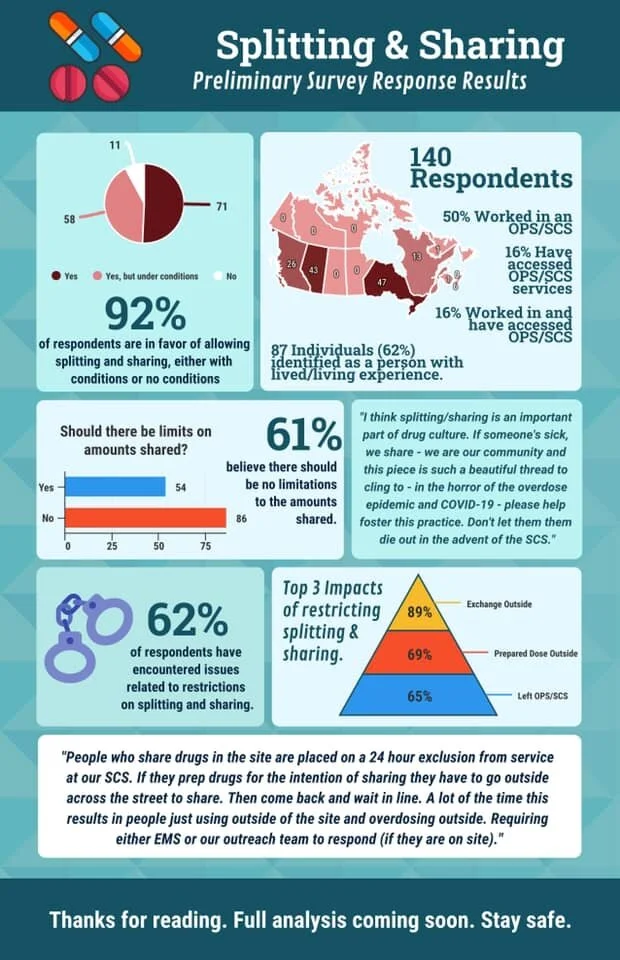
Splitting and sharing of drugs has long been practiced within communities of care of people who use drugs. Under current federal regulation, the practice is prohibited within federally-exempt supervised consumption sites (SCS), urgent public health need sites (UPHNS), and overdose prevention sites (OPS).
What’s been made abundantly clear through consultation with people who use drugs (PWUD), is that restrictions to splitting and sharing increases risk of physical and social harm such as overdose and criminalization. There are examples of countries outside of Canada (Australia and Switzerland) that have splitting and sharing within OPS/SCS as a practice.
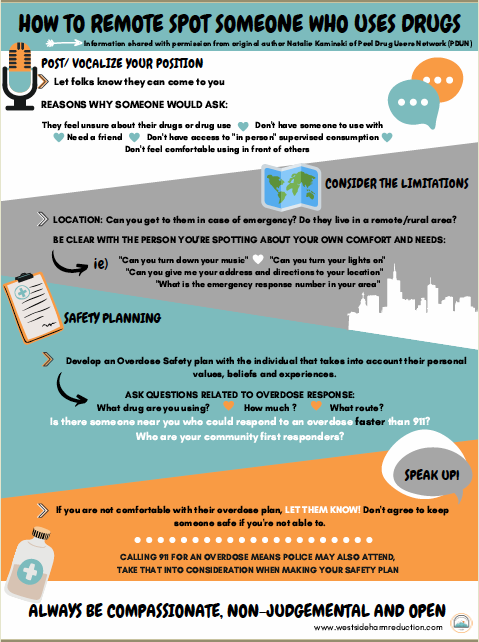
Virtual 'spotting' could help keep drug users safe during COVID-19, U of T researchers say
A group of researchers at the University of Toronto and the Canadian Association of People Who Use Drugs are studying a remote supervised-consumption model known as “spotting” to understand its benefits among people who use drugs during the pandemic.
The research team coined the term because the model involves a “spottee” consuming drugs in a safe location such as their home while a friend, family member or an acquaintance – the spotter –monitors them virtually.
“Before someone consumes a drug, they call their spotter on the phone who will be there on the call with them as they use,” says project lead Carol Strike, a professor at the Dalla Lana School of Public Health. “The spotter stays on the line with the spottee for another five to 15 minutes to ensure they are safe or call for help if needed.”
To continue reading click here for the full article.